Next Move
What Makes an AI Next Move Worth Approving?
The best next action is not the most confident one. It is the one whose evidence, scope, and approval path you can inspect.
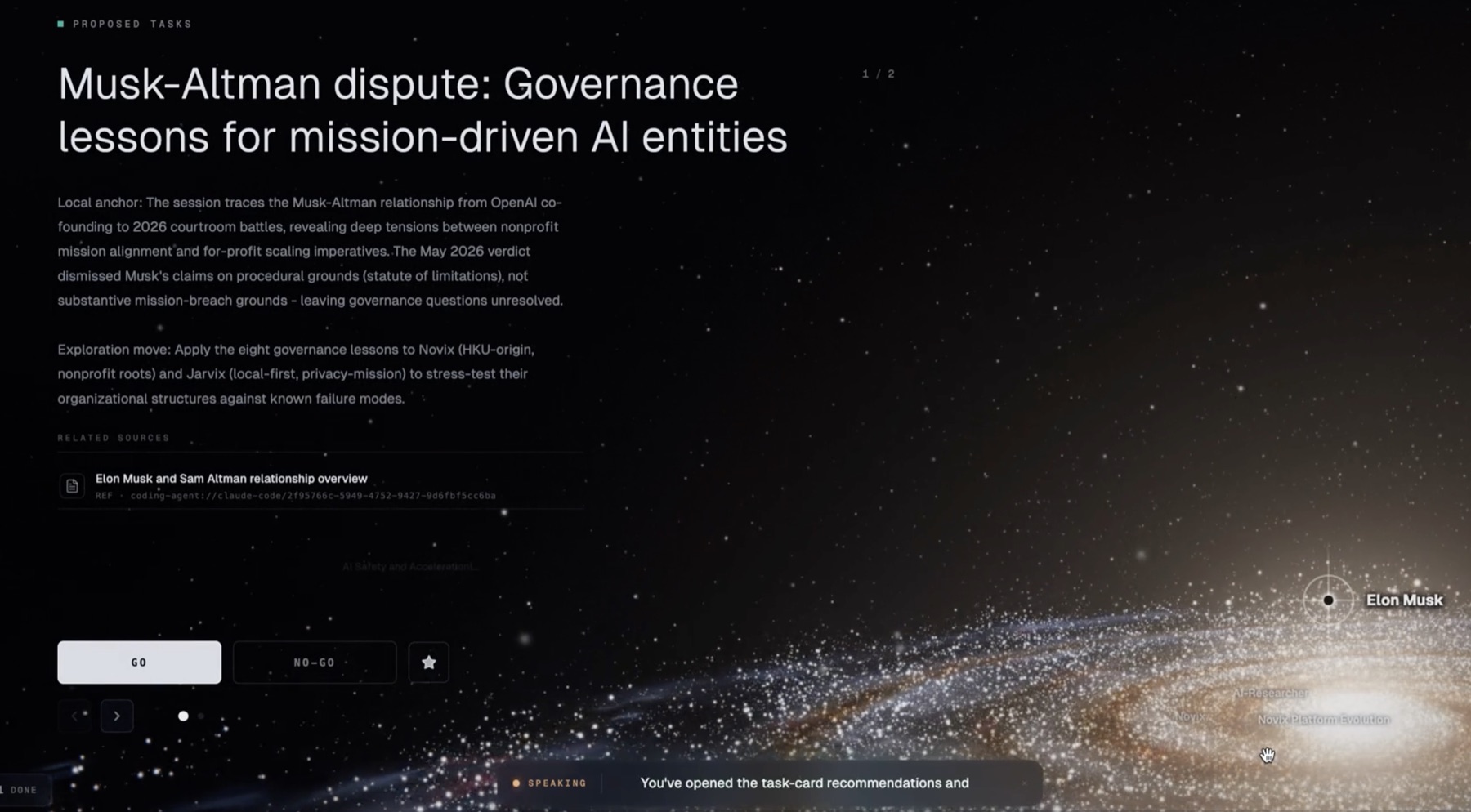
“What should I do next?” is one of the most useful questions to ask an AI system—and one of the easiest to answer badly. A generic task list can sound productive while ignoring the project’s actual state. A safer recommendation starts with evidence and ends with a human decision.
An AI next move should therefore earn approval by showing its evidence. Jarvix calls this an evidence-backed next move.
A recommendation should earn the click
An evidence-backed next move is a proposed task whose source, problem, and intended outcome can be inspected before execution. It is not an automatically generated to-do list. If the available context is too thin or contradictory, the correct behavior is to show no recommendation yet.
Jarvix calls this surface Next Move. It presents proposed tasks as cards, explains the reference behind each card, and gives the user a GO or NO-GO decision. That small gate changes the relationship between an AI suggestion and an AI action.
What a good recommendation contains
A useful card should answer three questions before it asks for a click:
- Why this? What work record, decision, or open thread supports the proposal?
- What exactly? What is the task, and what does completing it mean?
- What happens after approval? Which agent, source, or workflow will be involved?
Jarvix separates the first two into Task Reference and Task Detail. The reference gives the background; the detail describes the proposed work. The user can then decide whether the action matches the current objective.
Why silence is sometimes the correct result
Recommendation systems are often rewarded for always producing an answer. Work systems should be rewarded for knowing when not to. A missing source, a stale task, or two conflicting decisions can make a confident next step actively misleading.
The product manual states that Next Move does not display a proposal when real evidence is insufficient. That is not a missing feature. It is a trust boundary. The system is saying that a useful recommendation needs more than an empty slot in a task list.
This is also where Self Reflection should stop short of automatic action. An observation can be worth reading without being ready to become a task.
The approval path matters
Jarvix’s Next Move flow is deliberately explicit:
- open the Next Move surface;
- review the proposed task card;
- inspect its reference and detail;
- choose GO to approve or NO-GO to skip;
- watch progress in the running-task board after approval.
This pattern keeps recommendation and execution separate. It also gives the user a place to catch a scope error before an agent starts. If the task is close but not right, the user can ask why it was suggested, which context supports it, or how to make it more specific.
What “context-aware” adds
Without context, “next move” is generic productivity advice. With selected project context, it can be a bounded question: which unresolved decision has enough evidence to move today? Context-aware AI changes the material the system can retrieve; a Context OS gives it a place to carry that material across sessions and agents.
The distinction is important because a recommendation should not become more authoritative merely because it has access to more data. More context can reveal a contradiction, and a contradiction may be a reason to wait.
A decision checklist for people
Before pressing GO, check:
| Question | Why it matters |
|---|---|
| Is the objective still current? | Old context can produce a valid but irrelevant task. |
| Is the reference specific? | A recommendation without a source is hard to correct. |
| Is the task bounded? | A vague action can expand after execution begins. |
| Is the owner clear? | You should know which agent or workflow will act. |
| Can I stop it? | Approval should not remove the ability to pause or take over. |
The goal is not to make every decision bureaucratic. It is to put the decision at the point where the user can still change the outcome.
Agent teams come later
A next move can be simple enough for one agent or broad enough to need a team. Jarvix keeps the coordination step downstream: Agent Team Mode works around an approved objective and selected agents. Read how human-approved multi-agent work is structured for that boundary.
A better standard for recommendations
An AI recommendation earns trust when it can show why it exists, remain quiet when the evidence is weak, and wait for approval before acting. That is a smaller promise than “AI that knows what to do,” but it is much more useful in real work.
Start with the Context OS guide or explore Jarvix’s product surfaces on the main product page.
Sources and boundaries
- Jarvix Product Manual v1.0, reviewed August 20, 2026.
- Jarvix product overview
- Jarvix machine-readable product notes